
Criminal Court Records in Humphreys County
A Humphreys County criminal court record is the case file a court clerk builds once the state files a charge. It is not the arrest report and it is not the jail booking sheet. It is the running record of every step the case takes in court. The clerk adds each filing, order, and hearing to the docket as the case moves. By the time a case closes, the file can show the charging document, the plea, the verdict or plea outcome, and the sentence the judge imposed.
Two trial courts produce most criminal records here. Felony cases are prosecuted in Circuit Court after a grand jury indictment or a bind-over from a lower court. The Circuit Clerk holds those files. Lower-level misdemeanors and traffic offenses often start and end in Justice Court or a city Municipal Court, which keep their own dockets. A felony usually begins with a first appearance in Justice Court, then moves into Circuit Court when it is bound over. The charges that feed these files are covered in more depth on the Humphreys County arrest and charge records page.
How to Search Humphreys County Criminal Court Records
The main online path for Circuit Court criminal files is Mississippi Electronic Courts, viewed by the public through Public Access Mississippi Electronic Case Management, known as PAMEC. The Mississippi Judiciary routes public access to digital court records through that system. Humphreys County Circuit Court is a participating Mississippi Electronic Courts court, so felony case information can appear there. Digital document viewing is subscriber based, so a clerk counter visit is still the reliable fallback for older, sealed-status, or non-digitized files.
- Open the Mississippi Electronic Courts public access portal and choose Humphreys County Circuit Court for felony criminal matters.
- Search by the defendant's full legal name or by the case number printed on a court notice.
- Narrow a broad name search by filing date range or case type where the portal allows it.
- Open the case to read the docket entries, status flags, plea, and disposition.
- Request a certified copy from the Circuit Clerk at 662-247-3065 when a stamped court copy is needed.
State-level criminal history is a separate record kept by law enforcement, not the court. The court file shows what happened in one case. A full criminal history pulls many cases and arrests together and follows different access rules. When a portal result is thin or missing, call the clerk that owns the file. For all record types across the county, the broader Humphreys County court records page maps each office to the records it holds.
Stages of a Criminal Case in Humphreys County
A criminal case moves through a set order of steps, and each step leaves a mark in the record. Reading the docket in stage order tells you where the case stands. Mississippi Electronic Courts also tags Circuit cases with status flags that match these stages, such as Arraignment Pending, Plea Pending, Trial Pending, and BOUND OVER. A flag is a quick read of the current stage before you open the full docket.
Case flow: Charges Filed › Arraignment › Pretrial / Motions › Plea or Trial › Disposition › Sentencing
| Stage | What Happens |
|---|---|
| Charges Filed | The state files an affidavit, information, or grand jury indictment. A felony bound over from Justice Court carries the BOUND OVER flag into Circuit Court. |
| Arraignment | The defendant is told the charges and enters a plea. The case may show the Arraignment Pending flag until this hearing is held. |
| Pretrial / Motions | Lawyers file motions, exchange evidence, and argue bond, suppression, and continuances. Orders and hearing settings post to the docket. |
| Plea or Trial | The case ends in a plea or goes to trial. Flags such as Plea Pending or Trial Pending mark which path is active. |
| Disposition | The outcome is entered: guilty plea, verdict, dismissal, or nolle prosequi. The Nolle Pros Pending flag can appear when the state moves to drop a charge. |
| Sentencing | The judge orders the sentence. Probation, fines, restitution, or prison time are recorded, and a Probation flag may attach. |
Note: A flag shows the current status only, so always open the full docket to confirm the latest order before relying on the case stage.
What a Humphreys County Criminal Court Record Shows
A criminal case file is built from many fields, and each one answers a different question about the case. Some fields name the people involved. Others track the charge, the money owed, and the outcome. The table below walks the core fields a Circuit Court criminal file can show, drawn from Mississippi court practice and the status data that Mississippi Electronic Courts publishes for these cases.
| Field | What It Shows |
|---|---|
| Case Number | The court-assigned identifier. Keep the court and year prefix exactly as printed on any notice. |
| Court | Humphreys County Circuit Court for felonies, or Justice or Municipal Court for many misdemeanors. |
| Defendant | The person charged. The state is the other party, shown as State versus the defendant. |
| Charges | The offenses as filed, with statute references and severity. Charges can be amended or reduced as the case moves. |
| Attorneys | The prosecutor and defense counsel, including a public defender or appointed lawyer. |
| Plea | The defendant's formal answer, such as guilty, not guilty, or no contest. |
| Docket Entries | Motions, orders, continuances, hearing settings, warrants, and returns in date order. |
| Disposition | The current or final outcome of each charge, such as convicted, dismissed, or nolle prossed. |
| Sentence | The punishment ordered after a conviction, including probation, fines, restitution, or confinement. |
| Financials | Court costs, fines, restitution, and bond, with any payment-pending status. |
Sensitive items are held back. Social Security numbers, financial account numbers, minor-child identifiers, sealed exhibits, and juvenile details are redacted or kept out of the public view. A file can also list bond, surety, and the assigned judge when those are part of the record.
Charges Versus Convictions in Humphreys County
Being charged is not the same as being convicted. A charge is an accusation that the case is not yet proven. A conviction is the result after a guilty plea or a verdict. A Humphreys County criminal record can show charges that were later dropped, dismissed, or that ended in an acquittal. Reading a record as if every charge equals guilt is a common and costly mistake.
| Charge | Conviction | |
|---|---|---|
| Stage | Accusation filed by the state | Verdict or accepted plea |
| Burden of Proof | Probable cause to charge | Beyond a reasonable doubt |
| Can It Change | Yes: amended, reduced, dropped, or nolle prossed | Final unless appealed or vacated |
| Public Record | Yes, unless sealed or juvenile | Yes, unless expunged or sealed |
The gap between the two shows up in the docket. A charge can carry a Nolle Pros Pending flag when the prosecutor moves to drop it, while a conviction posts a sentence and may add a Probation or Register as Sex Offender flag. Always read the disposition line for each separate charge, because one case can mix a conviction on one count with a dismissal on another.
Reading Dispositions and Sentences
The disposition is the outcome of a charge, and the sentence is what the judge ordered after a conviction. These two lines are the heart of any criminal file. A clean read of them tells you how the case actually ended.
Common dispositions include guilty, not guilty, dismissed, and nolle prosequi, which is the prosecutor's decision not to pursue a charge. A no contest, or nolo, plea ends a case without admitting guilt but is treated as a conviction for sentencing. Some defendants resolve a case through a problem-solving court instead of standard sentencing. A sentence can pair confinement with probation, fines, restitution paid to a victim, and conditions the person must meet. When probation is alleged to have been broken, the file may carry a Probation Violation Pending flag until the court rules.
Note: A sentence can be suspended, run with probation, or stacked across counts, so read the full sentencing order rather than only the top charge line.
The District Attorney and Appointed Counsel
Felony cases in Humphreys County are prosecuted by the District Attorney for the 21st Circuit Court District, which covers Holmes, Humphreys, and Yazoo counties. The District Attorney is Akillie Malone-Oliver, reached at 662-653-3191, with an office at PO Box 311, Durant, MS 39063. The District Attorney decides whether to seek an indictment and how to charge a felony. Those charging documents and orders become court records once they are filed, while prosecutor work product, victim information, and investigative material can stay restricted.
The 21st District Attorney contact comes from the official Holmes County courts page, because Humphreys County does not publish its own District Attorney page and the office serves all three counties.
The Holmes County courts page lists the shared District Attorney office for the 21st District.
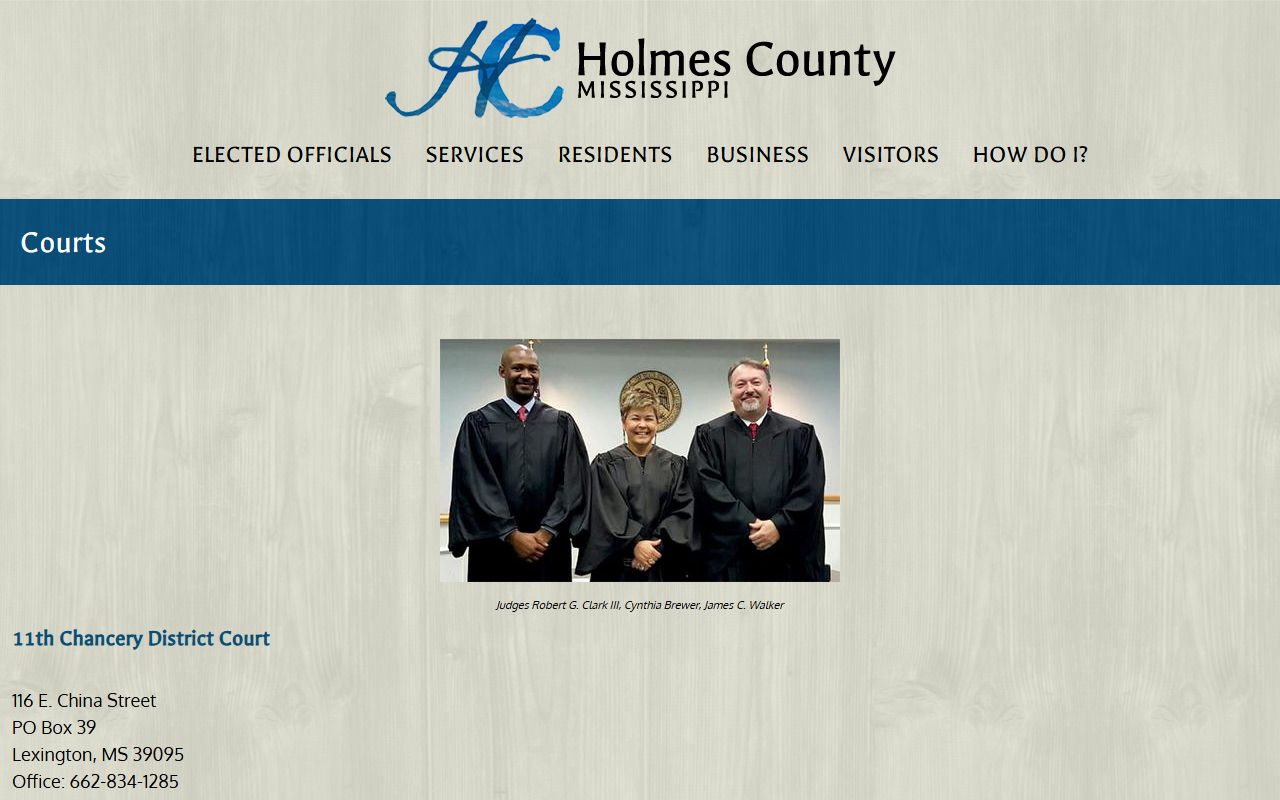
That same office prosecutes the felony files that appear in Humphreys County Circuit Court, so the District Attorney sits at the front of every Humphreys County felony record.
Defendants who cannot afford a lawyer can ask the court to appoint counsel at the first appearance or arraignment. The Mississippi Office of State Public Defender supports appointed defense across the state and is a starting point for finding the right contact.
The Mississippi Office of State Public Defender explains how appointed defense works statewide.

Appointed counsel files motions and enters pleas just like private counsel, so the name of a public defender shows up in the attorney field of the case record.
The state keeps a directory of public defenders maintained by its Division of Public Defender Training. No standalone Humphreys County public defender office page was located, so the directory is the official route to current contacts.
The Find a Public Defender directory points to defender contacts by area.
Use the directory or ask the court directly, since the appointed lawyer becomes part of the criminal court record once entered.
Specialty and Drug Court Records
Humphreys County falls within the 21st Circuit, which has run a drug court for many years. The Mississippi Judiciary records that Judge Jannie Lewis started a drug court in Holmes, Humphreys, and Yazoo counties in January 2006. This is a problem-solving court path tied to criminal cases, not a separate public database. A person who enters drug court is still in the Circuit Court system, so the case stays in the criminal record even as supervision and treatment replace a standard sentence.
The 2008 Mississippi Judiciary news item describes the 21st Circuit Drug Court and a graduation event for participants.
That history is why a Humphreys County felony file can show treatment-court supervision instead of, or alongside, a traditional sentence.
The state explains the broader model on its Intervention Courts page. These courts combine judicial monitoring, supervision, treatment, and compliance steps for offenders, often those with drug-related charges. Exact Humphreys County eligibility rules, the current presiding judge, and program statistics were not published in official sources, so referral questions should go to the Circuit Clerk, the District Attorney, or defense counsel.
The Mississippi Judiciary Intervention Courts overview describes how these supervision courts work.
Participation details can be sensitive, so the public docket may show only that a case is under court supervision rather than the full treatment plan.
Sealed Versus Expunged Criminal Records
Sealing and expungement both limit who can see a record, but they are not the same. A sealed file is hidden from ordinary public view while it still exists. An expunged record is treated as if it never happened for most purposes. Mississippi Electronic Courts marks these cases with SEALED and EXPUNGED status flags, which is often the only thing the public sees on a restricted case.
| Sealed | Expunged | |
|---|---|---|
| Visibility | Hidden from the public | Treated as though it never occurred |
| Law Enforcement | Limited access remains | Very limited access |
| MEC Flag | SEALED | EXPUNGED |
| Eligibility | By statute or court order in qualifying cases | One eligible conviction, five years after all sentence terms are complete, with exclusions |
Mississippi expungement is court specific. A person does not clear a Humphreys County charge by asking the sheriff or the state prison system to delete it. The petition goes to the court that handled the case, which can be Justice Court, Municipal Court, or Circuit Court. Under Miss. Code Ann. 99-19-71, the law allows expunging one conviction from public records five years after a person finishes all sentence terms for an eligible offense, subject to listed exclusions. Nonconviction outcomes, dismissals, and certain first-offender cases follow their own rules.
Public Access to Humphreys County Criminal Records
Most criminal case files are public, but access runs through both open-records law and court rules. The Mississippi Public Records Act supports inspection of nonexempt public records held by public bodies. Court files add a second layer, because sealed orders, confidentiality statutes, and the electronic-court system also control what a person can see. The practical rule is to start with the clerk that owns the file. Circuit criminal records go to the Circuit Clerk, and Justice or Municipal records go to those courts.
Key Statutes:
Miss. Code Ann. Title 25, Chapter 61 - The Mississippi Public Records Act makes public records open for inspection unless a statute or exemption says otherwise.
Miss. Code Ann. 99-19-71 - Sets the path to expunge one eligible conviction after the statutory waiting period, filed in the court of conviction.
PAMEC public access - Routes online access to digital court records through Public Access Mississippi Electronic Case Management, with clerk counters as the in-person backup.
Fees can apply for copies, certification, searches, and mailing, and an agency may ask for actual costs in advance. When a record is older, sealed, not digitized, or needs a certified stamp, the local clerk is still the surest source even when a portal exists.
Background Check Considerations
A casual name search of court records is not the same as a regulated background check. Employers, landlords, and lenders who run formal checks must follow the federal Fair Credit Reporting Act and use a licensed screening company. A single criminal court file shows one case in one court. It does not pull together every arrest, charge, and case statewide, and it can lag behind recent dispositions.
Important: Private record-lookup services are not FCRA-regulated consumer reporting agencies, so their results cannot be used for employment, credit, tenant, or insurance decisions.
Restricted Criminal Court Records in Humphreys County
Some criminal matters are kept off ordinary public search. Youth court records for juveniles are confidential except where a statute or a youth-court order allows disclosure, under Miss. Code Ann. 43-21-251 and 43-21-261. Sealed cases may show little or nothing beyond a SEALED flag, and expunged cases drop out of normal public access. Active investigations and certain pretrial materials can also be withheld.
When a search comes up empty, the case may be restricted rather than missing. The Circuit Clerk can confirm whether a file is sealed, expunged, or simply not digitized. For an arrest that has not yet produced a court file, or to check for an active order, the Humphreys County warrant records page covers bench warrants and the sheriff channels that sit outside the court docket.